Evaluating with AI: The Critical Role of Anchoring | LinkedIn

Inside the Push to Bring AI Literacy to Schools and Colleges - EdSurge News
Will AI literacy soon become as important a subject to teach in schools as reading, writing and math?Many education leaders think so, as ChatGPT and ...

Should I cite the AI tool that I used? *** by Dr. Kristin Terrill, Iowa State University — Academic Insight Lab
First, let’s disambiguate between two questions: should I cite the AI tool that I used, and how should I cite the AI tool that I used? The first question rests on the nature of your AI tool use, and to answer it, I will break down aspects of research into parts. The second question is proced

Practical GAI Strategies
The Practical Strategies… collection provides educators with clear, practical advice on using Generative AI

List of Resources
Books Book: AI Super-Powers: China, Silicon Valley, and The New World Order Book: Architects of Intelligence: The truth about AI from the people building it Book: Artificial Intelligence: A Guide f…

The Way We Assess What Kids Are Learning Is Changing
There's a revolution coming in how America's measures what students are learning and how to skills-based, relevant, and more engaging.

National centre for AI in tertiary education - Jisc
Accelerating the adoption of artificial intelligence across the tertiary education sector.

Dictionary.com | Meanings & Definitions of English Words
The world's leading online dictionary: English definitions, synonyms, word origins, example sentences, word games, and more. A trusted authority for 25+ years!

Day of AI

If Computer Science Is Doomed, What Comes Next?
After 50 years of programming, we humans still suck at it. "And I don't think another 50 years is going to solve it," Fixie co-founder Matt Welsh tells young developers.

Teaching Students to Write with AI: The SPACE Framework
Glenn M. Kleiman
To write effectively with the support of AI, students need to learn how to incorporate the following steps into the writing process:Set directions for the goals, content and audience that can be communicated to the AI system. This may, for example, involve writing introductory materials for the overall text and for each section. It could also involve writing much of the text and leaving some sections for AI to complete.Prompt the AI to produce the specific outputs needed. A prompt gives the AI its specific task, and often there will be separate prompts for each section of text. An AI tool can also be prompted to suggest sentences or paragraphs to be embedded in text that is mostly written by the human author.Assess the AI output to validate the information for accuracy, completeness, bias, and writing quality. The results of assessing the generated text will often lead to revising the directions and prompts and having the AI tool generate alternative versions of the text to be used in the next step.Curate the AI-generated text to select what to use and organize it coherently, often working from multiple alternative versions generated by AI along with human written materials.Edit the combined human and AI contributions to the text to produce a well-written document.The first letters of these steps form the acronym SPACE, so we call this the SPACE framework for writing with AI tools.

10 AI Skillsets for the Digital Native Educator -- THE Journal
These skills collectively empower educators to navigate and leverage the evolving landscape of generative AI to enhance teaching and learning in meaningful ways. Integrating AI into education requires a combination of these skillsets along with a forward-thinking and intellectually curious mindset.

Harvard Professor Explains Algorithms in 5 Levels of Difficulty | WIRED
From the physical world to the virtual world, algorithms are seemingly everywhere. David J. Malan, Professor of Computer Science at Harvard University, has been challenged to explain the science of algorithms to 5 different people; a child, a teen, a college student, a grad student, and an expert.
Correction: Our Level 2 teen, Lexi Kemmer, is actually 17-years-old.
Director: Wendi Jonassen
Director of Photography: Zach Eisen
Editor: Louville Moore
Host: David J. Malan
Guests:
Level 1: Addison Vincent
Level 2: Lexi Kemmer
Level 3: Patricia Guirao
Level 4: Mahi Shafiullah
Level 5: Chris Wiggins
Creative Producer: Maya Dangerfield
Line Producer: Joseph Buscemi
Associate Producer: Paul Gulyas; Kameryn Hamilton
Production Manager: D. Eric Martinez
Production Coordinator: Fernando Davila
Casting Producer: Vanessas Brown; Nicholas Sawyer
Camera Operator: Brittany Berger
Gaffer: Gautam Kadian
Sound Mixer: Lily Van Leeuwen
Production Assistant: Ryan Coppola
Hair & Make-Up: Yev Wright-Mason
Post Production Supervisor: Alexa Deutsch
Post Production Coordinator: Ian Bryant
Supervising Editor: Doug Larsen
Assistant Editor: Lauren Worona
Still haven’t subscribed to WIRED on YouTube? ►► http://wrd.cm/15fP7B7
Listen to the Get WIRED podcast ►► https://link.chtbl.com/wired-ytc-desc
Want more WIRED? Get the magazine ►► https://subscribe.wired.com/subscribe/splits/wired/WIR_YouTube?source=EDT_WIR_YouTube_0_Video_Description_ZZ
Follow WIRED:
Instagram ►►https://instagram.com/wired
Twitter ►►http://www.twitter.com/wired
Facebook ►►https://www.facebook.com/wired
Tik Tok ►►https://www.tiktok.com/@wired
Get more incredible stories on science and tech with our daily newsletter: https://wrd.cm/DailyYT
Also, check out the free WIRED channel on Roku, Apple TV, Amazon Fire TV, and Android TV.
ABOUT WIRED
WIRED is where tomorrow is realized. Through thought-provoking stories and videos, WIRED explores the future of business, innovation, and culture.

Torrey Trust, Ph.D. - Design Projects
ChatGPT Resources

Setting Ground Rules Around Original Writing and ChatGPT
Generative AI tools like ChatGPT have the power to revolutionize education, but educators must first wrestle with weighty ethical and practical concerns.

Simulating History with ChatGPT
The Case for LLMs as Hallucination Engines
Research on Innovative Technologies for Enhanced Learning (RITEL) (nsf23624) | NSF - National Science Foundation

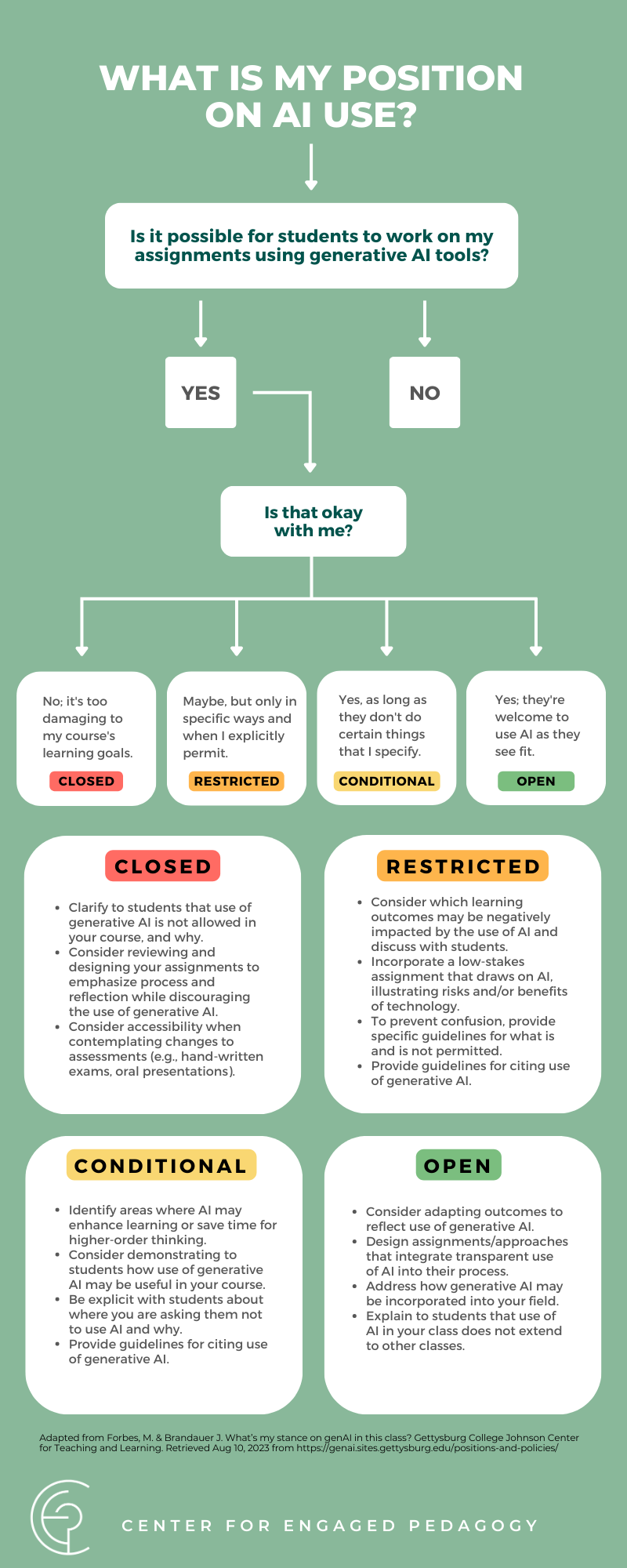
AI positions_0.png (800×2000)

ChatGPT Cheating: What to Do When It Happens
Experts caution against a punitive approach for students caught using the technology to cheat.

Student Use Cases for AI
Dive into this series of 4 student use cases for AI to discover how generative AI tools like ChatGPT can be used as a feedback generator, tutor, team coach, and learner. Get sample prompts and shareable guidelines to help students use AI tools effectively.
AFHSD Framework.pdf

Generative AI, plagiarism, and “cheating”
Back in January, I wrote a post called Beyond Cheating, reflecting on the ChatGPT bans that were rolling out across various Australian states and the “cheating” narrative that had accom…

One Day, AI Will Make Teaching Obsolete. As Educators, We Have a Different Role to Play. - EdSurge News
This past spring, I overheard one of my fifth graders boast that he would start using ChatGPT to do his homework. I chuckled because I knew him well ...

What to do about assessments if we can’t out-design or out-run AI? – Teaching@Sydney

MIT Technology Review
The narrative around cheating students doesn’t tell the whole story. Meet the teachers who think generative AI could actually make learning better.

Practical AI for Instructors and Students Part 5: AI for Students
In this module, we discuss how students can use AI to improve their learning and include guidelines and tips for getting the most out of the interactions. We provide example prompts, tips, and guidelines to help teachers communicate with students about the use of this tool.
This video is Part 5 of a five-part course in which Wharton Interactive provides an overview of AI large language models for educators and students. They take a practical approach and explore how the models work, and how to work effectively with each model, weaving in your own expertise. They also show how to use AI to make teaching easier and more effective, with example prompts and guidelines, as well as how students can use AI to improve their learning.
#AI #teaching #education
2:29 – https://www.oneusefulthing.org/p/my-class-required-ai-here's-what-ive
3:36 – https://annenberg.brown.edu/sites/default/files/EdResearch_for_Recovery_Design_Principles_1.pdf
4:39 – For this prompt, use either OpenAI's ChatGPT4 or Microsoft's Bing in Creative Mode: https://chat.openai.com/share/ec1018ec-1d86-4160-b587-354253c7d5cb
You are an upbeat, encouraging tutor who helps students understand concepts by explaining ideas and asking students questions. Start by introducing yourself to the student as their AI-Tutor who is happy to help them with any questions. Only ask one question at a time. First, ask them what they would like to learn about. Wait for the response. Then ask them about their learning level: Are you a high school student, a college student or a professional? Wait for their response. Then ask them what they know already about the topic they have chosen. Wait for a response. Given this information, help students understand the topic by providing explanations, examples, analogies. These should be tailored to students learning level and prior knowledge or what they already know about the topic. Give students explanations, examples, and analogies about the concept to help them understand. You should guide students in an open-ended way. Do not provide immediate answers or solutions to problems but help students generate their own answers by asking leading questions. Ask students to explain their thinking. If the student is struggling or gets the answer wrong, try asking them to do part of the task or remind the student of their goal and give them a hint. If students improve, then praise them and show excitement. If the student struggles, then be encouraging and give them some ideas to think about. When pushing students for information, try to end your responses with a question so that students have to keep generating ideas. Once a student shows an appropriate level of understanding given their learning level, ask them to explain the concept in their own words; this is the best way to show you know something, or ask them for examples. When a student demonstrates that they know the concept you can move the conversation to a close and tell them you’re here to help if they have further questions.
5:08 – https://papers.ssrn.com/sol3/papers.cfm?abstract_id=4475995
6:16 – https://www.aft.org/ae/spring2006/willingham
7:17 – https://papers.ssrn.com/sol3/papers.cfm?abstract_id=4475995
7:57 – https://teacherhead.com/2021/02/07/cold-calling-the-1-strategy-for-inclusive-classrooms-remote-and-in-person/
-----
Founded in 1881 as the world’s first collegiate business school, the Wharton School of the University of Pennsylvania is shaping the future of business by incubating ideas, driving insights, and creating leaders who change the world.
With a standing faculty of 241 renowned professors, Wharton has 5,000+ students across four degree programs: undergraduate, MBA, executive MBA, and doctoral. Each year 13,000+ professionals from around the world advance their careers through Wharton Executive Education’s individual, company-customized, and online programs – with 200,000+ others earning certificates from Wharton Online since 2015. More than 104,000 Wharton alumni form a powerful global network of leaders who transform business every day.
Learn more about Wharton: https://www.wharton.upenn.edu/
Subscribe to the Wharton YouTube channel: https://www.youtube.com/user/thewhartonschool/?sub_confirmation=1
ISTE Mini ebook final - Bringing AI to School–Tips for Leaders.pdf

Deepfake Types, Examples, Prevention
A deepfake is an AI-powered media that depicts a person in a manner that is not real. Learn how deepfakes are used in cybercrime and the relevant measures for protection.
Generative Artificial Intelligence in Teaching and Learning – MacPherson Institute

Building the new model for teaching and learning
OpenAI, assisted by Khan Academy, is building a new model for teaching and learning, to be called OpenAI Academy. At the center of the model is generative AI.